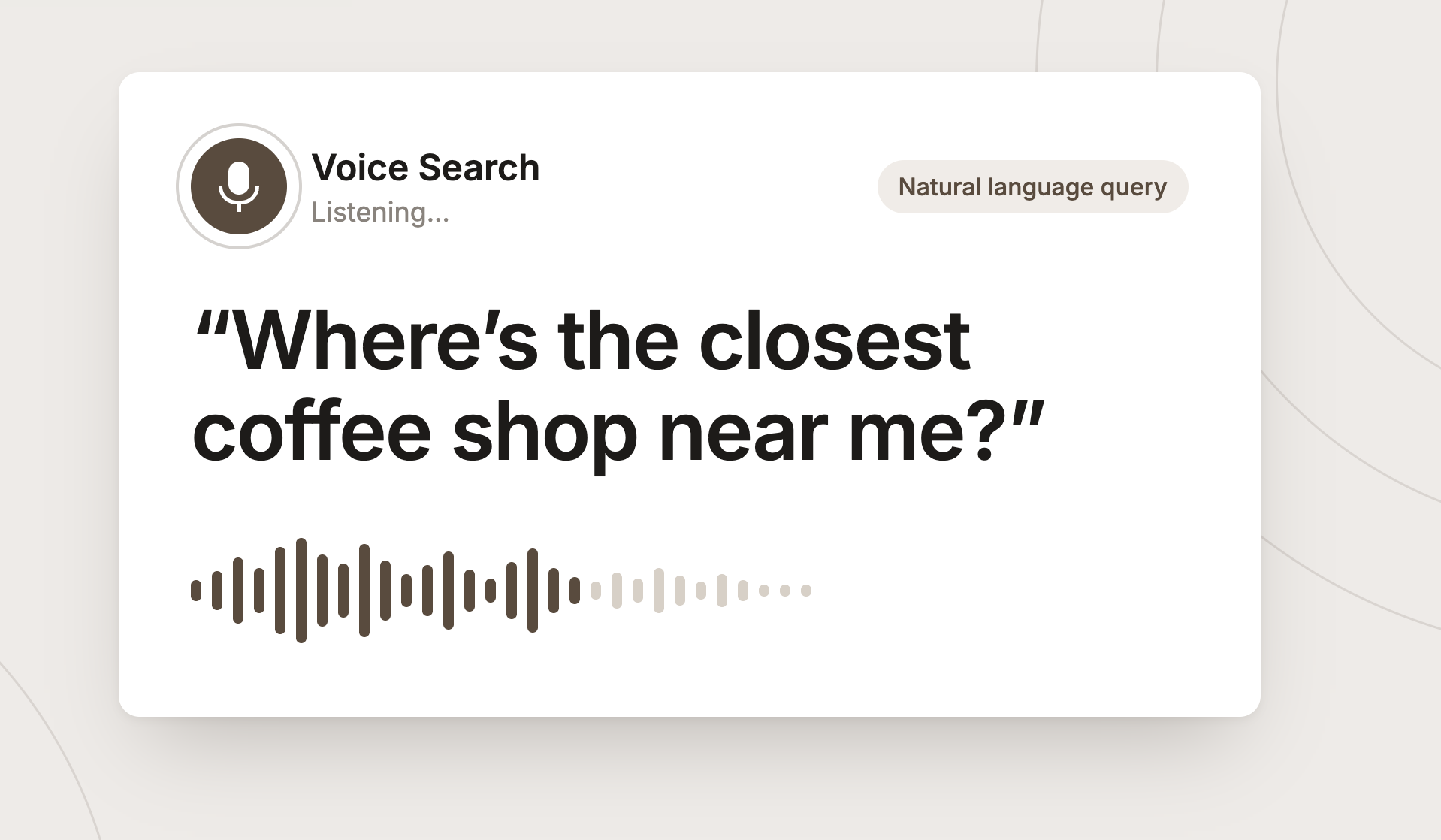
Have you started talking to your phone yet? Not talking to others via phone calls, but actually talking to your phone to ask it questions and give directions.
If you do, you’re one of the roughly 20% of people who use voice search to find resources on the web. You might be asking questions about finding places (like coffee shops), getting quick information (like weather reports), or learning quick facts (like unit conversions). And this trend is only going to grow.
For search marketers, the question is: “How can I get my brand into those searches?”
Is Search Visibility Even a Worthwhile Goal with Voice Searches? You might be thinking, “Search is irrelevant in this type of interface,” or you might point out that voice searches often happen through Siri or Alexa, not Google, so why does this matter for search marketing?
The answer: most voice searches are still powered by Google , even if they occur through another platform’s interface. For example, Siri uses Google Search for certain queries, and of course, Google Assistant uses Google Search for answers.
So, with these kinds of searches, your website still has a chance of providing answers and staying relevant to voice searchers, depending on your type of business, of course.
What Kinds of Businesses Benefit Most from Voice Searches? The types of businesses most likely to appear in voice search answers include:
Local service providers: restaurants, dental offices, plumbers, repair shops, and retail storesTravel and hospitality: hotels, vacation rentals, and attractions (“places to stay” and “things to do”)Healthcare and wellness: providers such as chiropractors, physical therapists, and clinicsThese kinds of businesses often appear in searches like:
“_____ near me” “Closest _____ to me” “What’s the best _____” “Where can I find a _____” Because voice queries are longer and more conversational, they typically take the form of natural language questions rather than short, typed keyword phrases. This is one of the defining qualities of voice search.
How to Build “Voice-Friendly” Web Pages If your prospects are using voice searches to find products and services like yours, here’s how to optimize your pages for them.
Use Conversational, Natural Language: Write in the tone people speak—longer, more question-style phrasing. Focus on conversational key phrases rather than short “SEO keywords.”Answer Questions Directly: Add an FAQ section. Use the question as a heading and provide a concise (1–2 sentence) answer immediately after. These bite-sized responses are more likely to appear as featured snippets that voice assistants read aloud.Aim for Featured Snippets (“Position Zero”): Structure content using paragraphs, bullets, and numbered lists. Keep direct answers short (30–50 words). Use schema markup (FAQ, HowTo, Q&A) to help search engines identify the correct answer text.Optimize for Local or “Near Me” Queries: Ensure your Google Business Profile (GBP) and local listings are complete and accurate—name, address, hours, and phone number. Mention your city, neighborhood, and nearby landmarks in your content for relevancy. Use phrases like “near me” or “in [city/neighborhood]” naturally where appropriate.Prioritize Page Speed and Mobile Usability: Voice search is mostly mobile (or smart-device based). Poor load times kill user experience. Use responsive design, compress images, minimize scripts, enable caching, and ensure HTTPS security.Use Structured Data (Schema Markup): Mark up elements like FAQ, HowTo, LocalBusiness, Product, and Review. This helps search engines parse your content and elevate the right snippets for voice results.Focus on “Zero Moment of Truth” Queries: Anticipate quick questions people ask in the moment—“What time do you close?”, “How much does shipping cost?”, “Do you offer returns?” Supply direct answers early in your content.Optimize Metadata and Readability: Use clear, descriptive titles and meta descriptions written in a conversational tone. Keep sentences short (under 20 words) and paragraphs brief (1–3 lines).Is This Worth Doing? Will It Pay Off? This is always the key question in SEO: If we do all this esoteric stuff, will my visibility rise, and will I get a return on my investment?
Here’s the answer: yes, it’s worth doing because these improvements enhance your website’s performance and user experience, even if they don’t produce an immediate SEO payoff.
Do you want your website to be fast and mobile-optimized? Yes. Do you want to answer your prospects’ questions in an easy, scannable way? Yes. It’s common sense marketing.
So do these things gradually, as your team’s bandwidth allows. Make them part of your standard operating procedure when developing new pages and content. That way, you’re using best practices not just for search marketing but as part of your everyday business.
You’ll be glad you did.