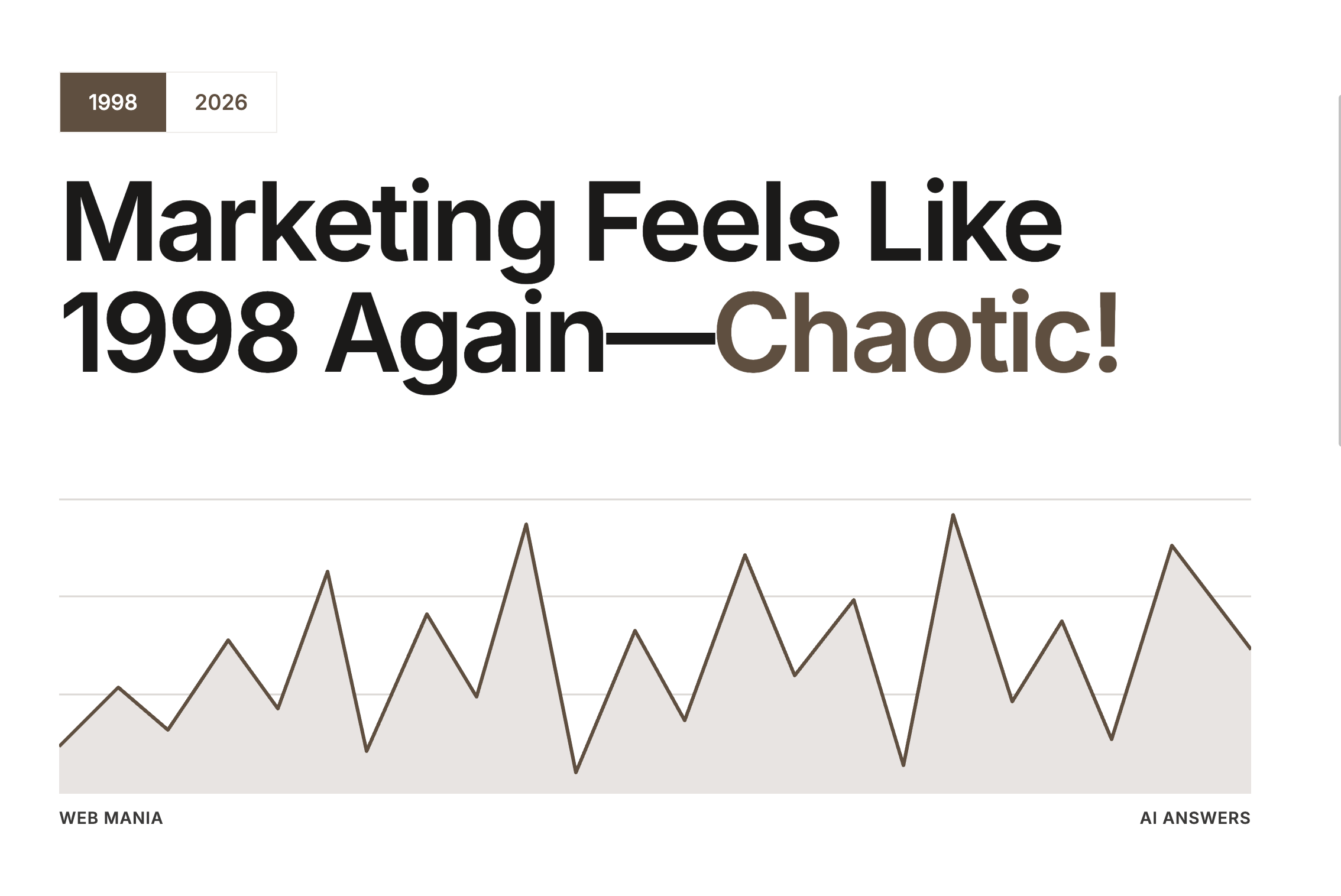
I just went for a walk with a friend who, like me, is a marketing consultant. We agreed this is a weird time for marketing, weird in the way it was weird when the internet arrived. Big changes are happening and it's hard to know exactly what's going on beyond the sense that big things are afoot and we're headed into a future that won't look much like the past.
I started my first firm in 1998, so I had a front row seat the last time everything changed. With that walk as the catalyst, here's my take on where things stand.
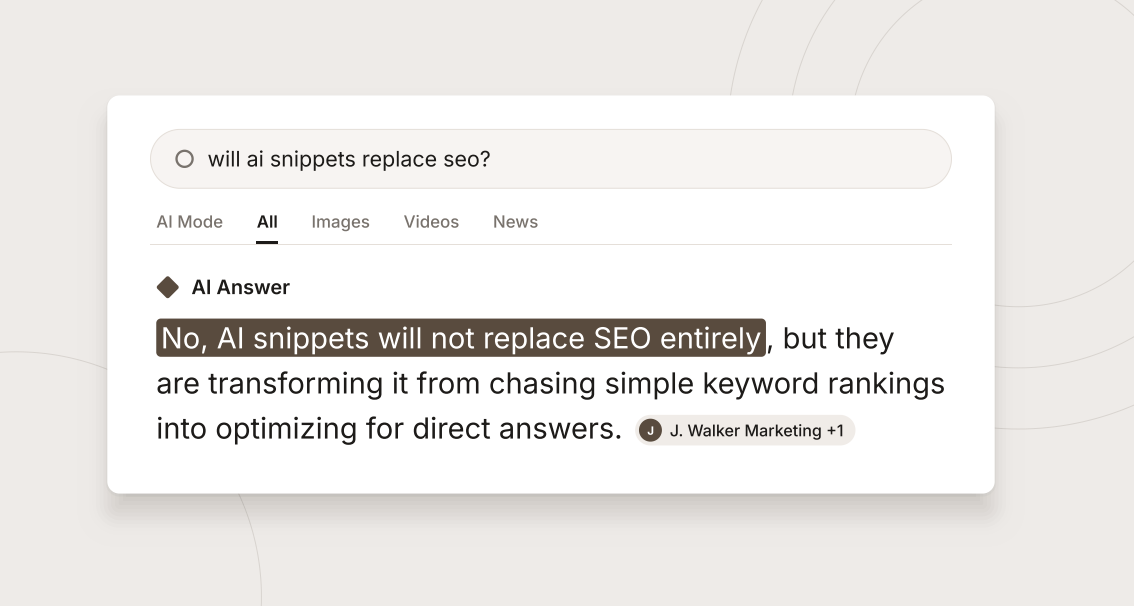
There's Massive Uncertainty The crux of what's happening is that AI is changing how we get answers to our questions.
For more than 20 years, we've used search engines to answer our questions. At first there were a lot of them. Then there was just one that mattered: Google. It answered our questions by sending us to websites where the answers lay. That system relied on one major search engine and a gazillion websites; a lot of marketing worked inside that ecosystem. The search engine directed traffic and websites received it.
That's changing, because AI now gives answers without anyone having to visit a website at all. When Pew Research Center studied real browsing data from March 2025, it found that Google users clicked through to a website 8% of the time when an AI summary appeared, compared with 15% when one didn't. Only 1% clicked a link inside the AI summary itself. Meanwhile, OpenAI reported that ChatGPT reached 900 million weekly users in February 2026, more than double the number a year earlier.
This is a massive change, and it raises fundamental questions for marketers:
• Are websites still important?
• Should we be optimizing for AI engines instead of search engines?
• Can brands be part of the answers AI gives?
Consumer Uncertainty Creates Marketing Uncertainty Marketing relies on understanding consumer behaviors and preferences, and right now both are influx. People are adopting AI rapidly, yet they're uneasy about it and unsure how much they want to let it into their lives. AI is amazing, powerful, and useful. It's also scary.
The numbers bear this out. In a June 2026 Pew survey, 52% of Americans said they were more concerned than excited about the growing use of AI in daily life, up from 37% in 2021. Only 9% said they were more excited than concerned.
So people are using AI more and trusting it less, at the same time. When consumer behavior is that contradictory, it creates a blur of uncertainty for marketers. That's the world we've entered.
How Should We Cope? This period feels like the internet revolution to me. Here's what I learned last time, for what it's worth. (Yes, a few of these are predictions, and the first lesson says to take predictions with a grain of salt.)
• Much of what we predict will be wrong. In early 2024, Gartner predicted that traditional search engine volume would fall 25% by 2026 as people switched to AI chatbots. Here we are in 2026, and search hasn't collapsed. What changed was subtler: people still search, but they click through to websites less often.
• The people who speak with the most certainty about the future will often be the most wrong.
• It's better to admit ignorance and keep learning than to fake mastery.
• First-mover advantage is overrated. Google wasn't the first search engine; it came after AltaVista, Yahoo, Lycos, and Excite. Facebook came after Friendster and MySpace. Pets.com was one of the early movers in online retail and was gone by the end of 2000. Second movers learn from the early failures.
• "AI businesses" will eventually just be businesses powered by AI, the same way "internet businesses" became ordinary businesses that use the web.
• Consumer behaviors will stabilize as habits form, and that will help marketers relearn how to reach people.
What We Can Still Count On While we feel our way through the fog, we need to lean on a few things we're sure of.
• Human beings are the audience. Write for them, speak to them, and work to understand them.
• When the data is blurry, the most important metric is the sale. If AI means fewer people click through to your website, traffic and clicks can't be your main scorecard anymore. Leads and sales still tell the truth.
• Brands still matter, because a brand is "a shortcut to a good purchase decision." One of my earliest clients used to say that. I think it's still true, and maybe even more true than ever, now that people are getting answers from a machine they don't fully trust.
Nobody has this figured out yet, including me. I'd love to hear what you're seeing. Share what's changed in your marketing over the past year, and what's stayed the same? Let’s walk through this fog together.